For early-stage parents, learning that their baby exhibits auditory issues almost always feels terrifying and sad. Fortunately, the encouraging truth is that via early testing and professional support, young patients with hearing challenges are able to prosper wonderfully. Without question, these babies can construct clear speech, social competencies, and enduring bonds within their community, realizing a wonderful life!
Integrating standard hearing devices with modern cochlear technology provides two highly successful solutions for supporting infants who exhibit hearing loss. Within this detailed breakdown, we assess their basic functions and explain how to choose the ideal device for your child.
Demystifying Hearing Deficits in Newborns
Congenital hearing impairment in infants often occurs because of diverse root causes, such as:
- Genetic factors (even without an established family history)
- Maternal pathogen exposures such as cytomegalovirus (CMV) and rubella agents
- Delivery difficulties, including acute oxygen deprivation or early birth
- Particular clinical medications given during neonatal intensive care stays
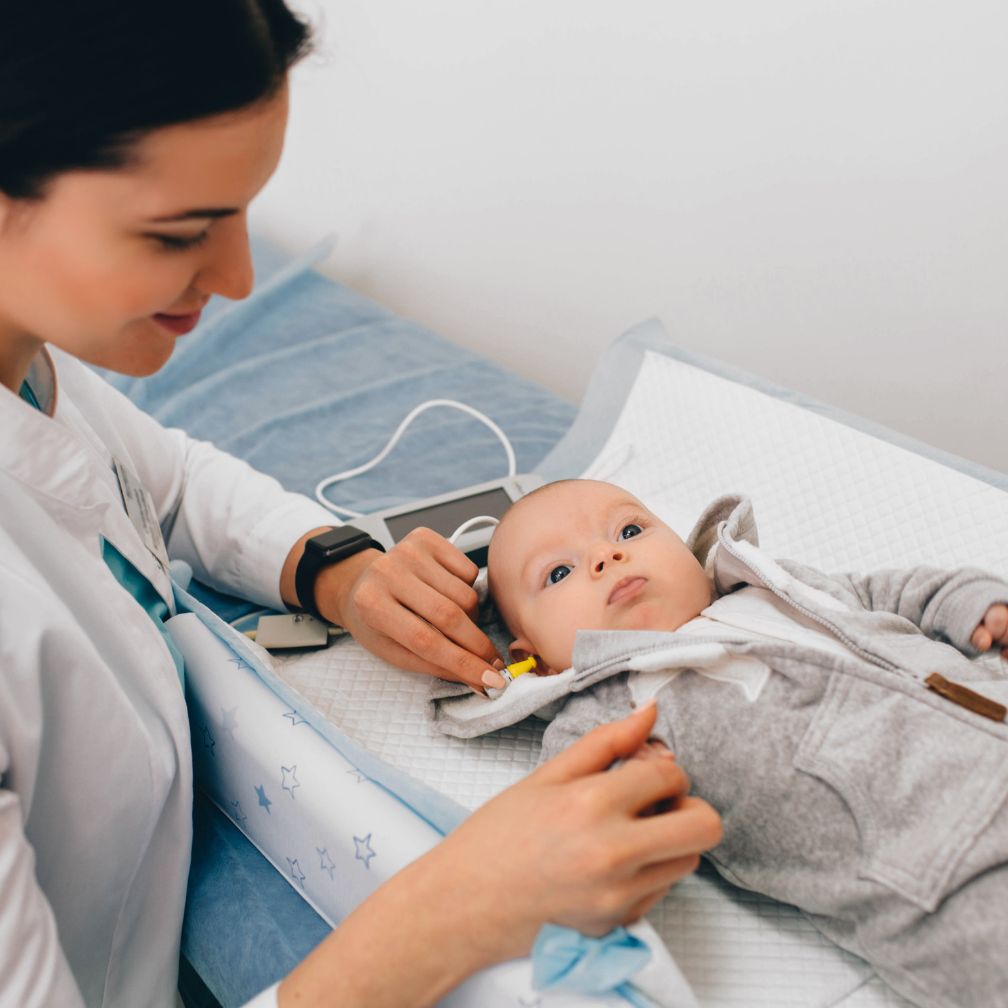
What remains the single most critical task? Timely diagnostic identification. As a result, babies within American hospitals complete screening procedures prior to returning home. Specialized pediatric auditory doctors enforce the universal “1-3-6” diagnostic framework:
- Completely screened prior to 1 month of age
- Official diagnostic verdict secured inside 90 days of life
- Prompt intervention (employing amplification units or structured therapy) launched inside 180 days of birth
Achieving these diagnostic benchmarks offers babies the optimal foundation for robust speech, linguistic, and neurological growth. Whenever you seek direction regarding these evaluations, your family pediatrician will gladly help!
Understanding Amplification Devices for Infants
In cases where babies exhibit mild to severe hearing challenges, fitted hearing aids regularly function as the initial intervention option. Such light, wearable units intensify sound signals, helping infants distinguish human speech and natural sounds more clearly.
Modern pediatric hearing aids remain:
- Thoroughly safe for use with young infants just a few weeks after birth
- Designed with soft, comfortable ear molds that adjust alongside the infant’s growth
- Built featuring child-resistant battery compartments plus specialized safety features geared toward babies
- Uniquely tuned by a licensed pediatric audiologist to accommodate your child’s specific hearing levels
As your child matures, hearing devices require routine recalibration to ensure proper fit and effectiveness.
Pediatric Cochlear Implants: An Advanced Solution
If a baby has severe to profound sensorineural hearing deficits and derives limited success from conventional hearing aids, clinical teams frequently recommend a cochlear implant. Differing from standard hearing aids, cochlear implant systems:
- Must be placed via a specialized surgical procedure within the patient’s inner ear
- Completely circumvent non-functional elements inside the cochlear pathway
- Convert sound waves into focused electrical signals that directly excite the acoustic nerve
Standard cochlear implants remain:
- Formally FDA-sanctioned for use with pediatric patients as young as 9 to 12 months
- Highly effective when supported through early therapy programs and dedicated household support
- Recommended solely following exhaustive clinical evaluations by a pediatric audiologist and ENT specialist
That pre-surgical path incorporates imaging, hearing tests, and open dialogue concerning long-term communicative results.
Contrasting Hearing Aids with Cochlear Implants
- Mild to severe hearing loss: Hearing Aids; Severe to profound hearing loss: Cochlear Implants
- Non-Invasive external fitting: Hearing Aids; Invasive surgical procedure: Cochlear Implants
- Acoustic volume boosting: Hearing Aids; Electrical signal stream conversion: Cochlear Implants
- Intervention starts in early infancy: Hearing Aids; Starts at 9-12 Months: Cochlear Implants
Final Conclusions: Selecting the Right Path for Your Infant
If your baby has been diagnosed with hearing loss, rest assured that clear options and plenty of support. Under the care of specialized pediatric hearing doctors, a vast majority of children attain speech and language proficiency that rivals their normal-hearing peers.
No matter if your infant proves better suited for conventional hearing aids or advanced cochlear implants, taking immediate action creates a profound lifelong advantage.
Are you seeking answers about your child’s overall hearing wellness? Contact our clinical team today to schedule a thorough assessment and individualized management strategy.