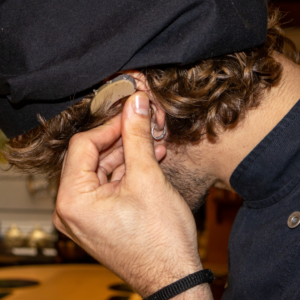

Many people delay getting hearing aids because they don’t think they’ll like how they look or feel. Such reluctance is perfectly natural when you consider past technology! Furthermore, many individuals harbored deep anxieties about social isolation, fearing others would exclude them from discussions based on assumptions of cognitive decline or profound auditory deficits.
Consequently, this outdated, negative stereotype persists, preventing numerous individuals from seeking professional care. But the reality is that today’s modern hearing aids look and feel very different from what you might expect. Advances in design and technology have made them smaller, more comfortable, and far more discreet.
Should your reluctance stem entirely from memories of obsolete, bulky hardware, you owe it to yourself to discover current medical advancements.
The Outdated Devices of Your Imagination Have Been Replaced
If you close your eyes to conceptualize a hearing system, your mind likely crafts a picture of a prominent, cumbersome unit draped behind the ear. Should that be your current expectation, you are inadvertently recalling the clunky designs common to the 1980s and 1990s.
In the intervening decades, the entire field of otolaryngology and acoustic engineering has undergone a massive paradigm shift. Exponential leaps in digital circuit shrinking, industrial design, and audio computing have totally redefined contemporary hardware. They’re smaller, sleeker, and designed to blend in (or disappear entirely).
A multitude of current designs fit entirely inside the physical ear canal, ensuring they remain hidden from view during normal social encounters. Different configurations sit comfortably behind the ear but feature such a low profile and featherweight build that observers naturally miss them.
Primary Hearing Aid Styles, From Invisible to Barely There
If you’re wondering what your main options in hearing aids actually look like, here’s a simple breakdown:
Invisible-in-Canal (IIC) Technology
This specific configuration offers the highest degree of user discretion. An IIC device is positioned entirely past the second bend of the auditory canal, fabricated from a personalized physical matrix of your unique anatomy. When engaging with others at standard social distances, these units are utterly unnoticeable to the naked eye. They remain an exceptionally sought-after solution for patients with mild-to-moderate deficits who refuse to compromise on cosmetic privacy.
Modern Standards: Receiver-in-Canal (RIC) / Receiver-in-the-Ear (RITE)
Statistically, this open-fit design represents the dominant choice among current consumers. A tiny component sits behind the ear, connected by a nearly invisible wire to a small speaker in the ear canal. To a casual observer, their clean lines often mimic high-end commercial wireless earbuds. Most people won’t notice them unless they’re looking.
Streamlined Behind-the-Ear (BTE) Systems
These units reside entirely behind the external ear, providing a slightly larger chassis that is still infinitely more elegant than historical variations. Frequently utilized to remediate severe-to-profound auditory loss, they maximize gain and processing capability while maintaining a highly professional, low-profile aesthetic.
Ultimately, contemporary hearing aids are built to empower your daily routine rather than broadcast a medical condition to the world.
The Functional Revolution: Modern Instruments Are Tiny Supercomputers
The changes in modern hearing aids aren’t just cosmetic. Present-day models perform like advanced personal audio computers instead of basic medical listening aids. Most current systems boast universal wireless syncing, channeling smartphone calls, high-definition music, and television broadcasts directly to your internal receivers.
Equipped with dedicated smartphone applications, they allow users to manipulate volume matrices or toggle environmental programs without making manual physical adjustments. Should you transition into a loud social environment, you can instantly recalibrate your directional microphones via your phone screen. Rechargeable batteries have also replaced the tiny ones people used to struggle with. The process is as simple as placing the units into their charging dock each night, identical to charging your cell phone.
Dismantling the Emotional Stigma of Auditory Assistance
Even knowing all of this, it’s easy to hesitate. Exploring hearing aid options can be challenging on a mental and emotional level because it’s an admission that our hearing isn’t what it used to be. This can make us feel helpless and like we aren’t fully in control of what’s happening to our bodies.
Let’s reframe this narrative completely: acquiring a modern acoustic instrument is not an admission of weakness. They’re simply a sign of change, which happens to us all. They’re proof that you’re taking action to support and equip your body in essential ways.
Imagine wearing a discreet, barely (if at all) visible device and finally being able to follow along in conversation, hear better in crowds, and focus on the things that really interest you. Talk about empowering!
Schedule Your Personal Demonstration of Today’s Top Styles
To dismantle old assumptions, the best strategy is to witness these design breakthroughs with your own eyes. We encourage you to drop by our office, address your concerns, and hold these miniature devices yourself with zero sales pressure. Treat this as a risk-free exploratory step to comprehend the incredible aesthetic shift that has occurred in our field.
The overwhelming majority of our patients leave their consultation thoroughly amazed by the compact scale, luxurious comfort, and acoustic clarity of current technology! Please contact our patient care coordinators or utilize our digital portal to secure your consultation this week.